
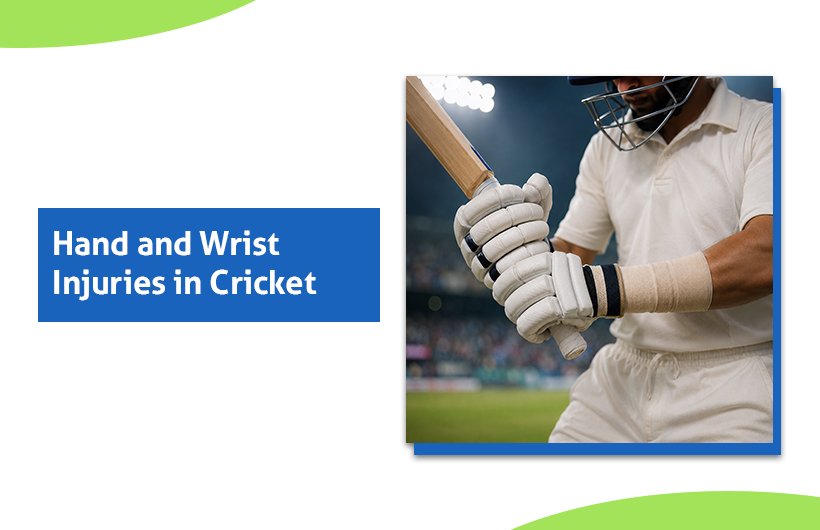
A cricket ball weighs 156 grams and can travel at more than 140 km/h. When it strikes the hand at the wrong angle, the outcome depends largely on the player’s role.
A batter’s hand injury looks nothing like a wicketkeeper’s. A keeper’s injuries are different from a fielder’s. Yet most information on hand and wrist injuries in cricket treats all three roles the same way, which is why so many of these injuries get mismanaged in the field. A finger that looks “jammed” is sometimes a fracture. A wrist that feels like a sprain is sometimes a scaphoid fracture, and a missed scaphoid fracture can permanently damage the wrist if left unaddressed for weeks. As an orthopedic surgeon in Ahmedabad working with cricketers across Gujarat, I see this entire spectrum. This guide breaks it down by role, tells you what to look for, and explains when getting it assessed quickly actually matters.
Batters: When the Ball Finds the Handle
For batters, the hands are at the center of every delivery faced. The injuries that result are mostly blunt force, the ball catching the edge and cramping the bottom hand on the grip or arriving sharply onto exposed knuckles.
Bottom hand knuckle fractures and contusions are the most common contact injuries for right-handed batters. The fourth and fifth metacarpals of the left hand, the bones running from the wrist to the knuckle, take direct ball impact on mishits. Most of the time, the result is severe bruising and swelling. Occasionally, it is a fracture, and the two can look identical in the dressing room without an X-ray.
Thumb UCL tears occur when the bat is gripped tightly and a rising delivery beats the bat. The thumb is forced into hyperextension, stretching or tearing the ulnar collateral ligament on the inner side of the thumb base. This is the same mechanism as “skier’s thumb” and in its complete form, it does not heal with rest alone. A batter who continues playing through an unstable thumb UCL risks chronic instability that cannot be fully corrected later. Surgical repair of a complete UCL tear, performed early, produces excellent results.
Hook-of-Hamate fractures are less common but worth knowing. The hamate is a small wrist bone on the little-finger side, and its hook-shaped projection sits almost exactly where the bat grip rests in the palm. Repeated impact, particularly in players who bat long innings or spend heavy time in the nets, can fracture this hook. The pain is on the palm side of the wrist rather than the back, and it is often dismissed as grip fatigue or a minor bruise. A plain X-ray can miss it; a CT scan is the right investigation when this fracture is suspected.
Wicketkeepers: Why Your Fingers Take the Most Punishment
Wicketkeepers absorb more hand-injury stress than any other position in cricket. Repeatedly collecting deliveries, reacting to glancing balls, and diving for stops make finger and thumb injuries less an exception than an expected part of a long career.
Mallet finger is the most characteristic injury among wicketkeepers. It occurs when a ball strikes the tip of an extended finger, forcing it sharply downward, either tearing the extensor tendon or pulling off a small bone fragment from the fingertip. The result is a drooping fingertip that the player cannot actively straighten. Keepers often tape their fingers and continue playing, but this is a serious mistake. If left untreated for more than 6 to 8 weeks, mallet finger becomes much harder to treat, and in some cases, the deformity can become permanent.
Treatment for a purely tendinous mallet finger is a Stack splint worn continuously for 6 to 8 weeks, holding the fingertip in full extension. Removing it even briefly resets the treatment clock. For bony mallet injuries where a fragment has been avulsed, surgical fixation is sometimes required.
PIP joint dislocations and volar plate injuries are the second-most common keeper injuries. The proximal interphalangeal joint, the middle knuckle, is forced backward on impact, partially or fully dislocating and tearing the volar plate, a small cartilage structure on the palm side of the joint. These are routinely “popped back in” on the field and strapped, then played through. What gets missed is the underlying volar plate injury. If not managed properly, this leaves a stiff, chronically swollen “sausage finger” for months. An X-ray after joint reduction is important to rule out a small intra-articular fracture.
Thumb base fractures, specifically Bennett’s and Rolando fractures, occur when a keeper catches a delivery directly on the tip of an abducted thumb. These are fractures at the base of the first metacarpal that involve the joint surface, and the pull of surrounding muscles almost always displaces the fragment. They need surgical fixation. A thumb that is still swollen and painful two weeks after a direct impact should be X-rayed. This is precisely the injury that gets dismissed as a sprain at first presentation.
Fielders: The Injury Nobody Anticipates
Fielding injuries to the hand are almost always unplanned. A dive, a misjudged ball, a hand reaching for the ground instinctively: the mechanism is typically a fall, not a deliberate collision.
Scaphoid fractures from diving are the most clinically significant hand injury for fielders and one of the most missed fractures in sport overall. The scaphoid is a small carpal bone on the thumb side of the wrist. It fractures when a fielder dives and lands on an outstretched hand with the wrist extended backward.
The injury presents wrist pain and tenderness in the anatomical snuffbox, the small hollow between the thumb tendons, when the thumb is raised. This is often dismissed as a wrist sprain because the pain is manageable and the mechanism seems minor. That is the critical mistake.
The scaphoid has a precarious blood supply. A fracture through the waist of the bone can cut off circulation to a portion of it. Without blood supply, that segment begins to deteriorate, a process called avascular necrosis. This typically develops within 4 to 8 weeks of an untreated injury. By the time a fielder returns after a “sprain that hasn’t settled,” the damage may already be progressing toward a complication that requires reconstructive surgery rather than a straightforward screw fixation.
A plain X-ray misses roughly 20 to 30% of acute scaphoid fractures. Any fielder with anatomical snuffbox tenderness after a wrist hyperextension injury should have an MRI within the first two weeks, even if the X-ray appears completely normal.
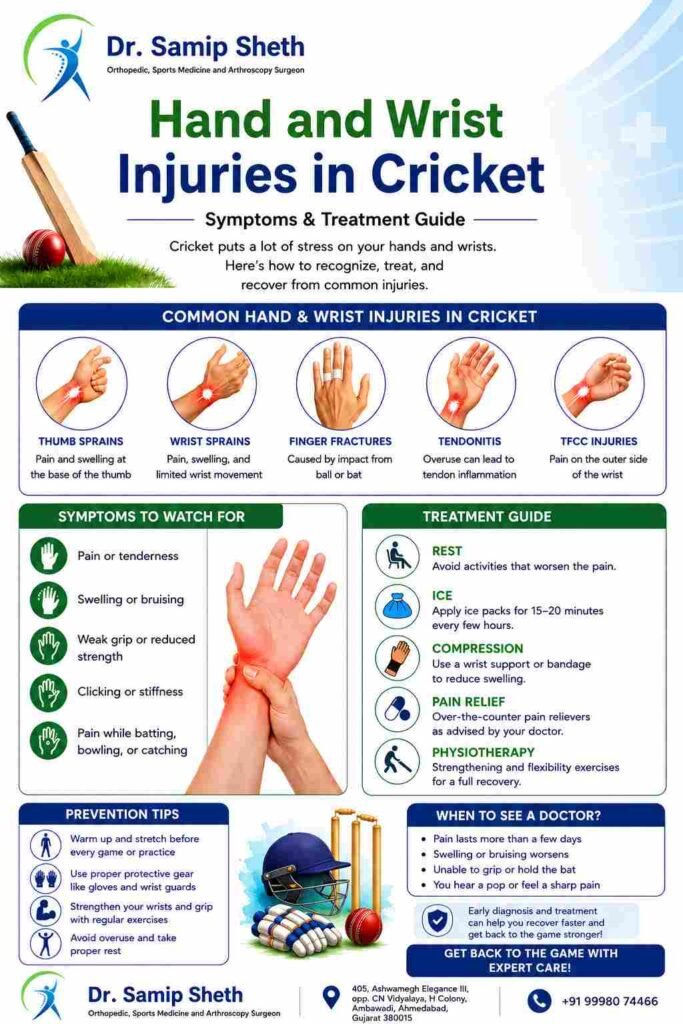
TFCC tears are also seen in fielders taking hard throws on a slightly rotated wrist. The Triangular Fibrocartilage Complex is the cartilage and ligament structure on the little-finger side of the wrist that cushions and stabilizes the joint. A TFCC tear causes clicking, ulnar-sided wrist pain, and a gradual loss of grip strength. Milder cases settle with immobilization and physiotherapy. Persistent or complete tears are addressed with wrist arthroscopy.
When Buddy Tape and Playing on Is Not Enough
Cricket has a deep culture of playing through hand injuries. Taped fingers and gritted teeth are almost a rite of passage. For minor contusions and stable sprains after proper assessment, continuing to play is reasonable. For the injuries described above, it is not.
Signs that need proper orthopedic assessment before returning to the field:
- Any finger that cannot be actively straightened at the tip
- Wrist pain after a hyperextension fall that persists over one week
- A thumb that feels unstable or loses grip strength after a direct impact
- A knuckle that remains significantly swollen after 48 hours
- Clicking or a catching sensation in the wrist after a diving injury
- Any joint that was dislocated on the field, even if it was put back in, it needs an X-ray
The same principle that applies to knee injuries in cricket applies to the hand: rest is the beginning of management, not the entirety of it.
Treatment: From Splinting and Casting to Wrist Arthroscopy
Most hand and wrist injuries in cricket are treated without surgery. The pathway depends on the injury type and how quickly it is assessed.
Splinting and immobilization are appropriate for mallet finger, displaced scaphoid fractures, stable finger fractures, and PIP joint injuries. Strict compliance matters; removing a splint early is the most common reason manageable injuries become complicated ones.
Buddy taping works for stable ligament sprains of the fingers after imaging has confirmed no fracture or joint instability.
Surgical fixation is needed for displaced scaphoid fractures, Bennett’s fractures, complete thumb UCL tears, and hook-of-hamate fractures unresponsive to conservative management.
Wrist arthroscopy is used for TFCC tears, wrist ligament injuries, and complex intra-articular wrist problems. The technique is the same minimally invasive camera-guided approach that Dr. Samip Sheth uses for shoulder arthroscopy in Ahmedabad small incisions, direct visualization of the joint, and the ability to diagnose and treat in a single procedure with faster recovery than open surgery.
Getting the Diagnosis Right Is Half the Treatment
Cricket hand and wrist injuries are very treatable almost across the board when they are assessed and managed early. The injuries that become chronic, require complex surgery, or cause permanent limitation are nearly always those that were dismissed as sprains and left too long.
If you are a cricketer in Ahmedabad with a hand, wrist, or finger injury that has not settled after a week, the right step is a clinical assessment with imaging. Contact us to book a consultation at our clinic in Ambawadi, Ahmedabad. For a faster response, reach us directly on WhatsApp.
Don’t Let Joint Pain Hold You Back
Whether you’re dealing with a sports injury, knee pain, shoulder pain, ligament tear, or persistent joint discomfort, early diagnosis can prevent long-term damage. Consult Dr. Samip Sheth, an experienced Orthopedic and Sports Injury Specialist in Ahmedabad, for expert evaluation and personalized treatment.
Frequently Asked Questions
Q: Can I keep wicket with a mallet finger if it is taped?
A: Not without proper assessment. Taping in the wrong position can worsen the injury. Mallet finger needs the fingertip held in full extension continuously for 6 to 8 weeks; partial support is not enough. Playing through it risks a permanent droop.
Q: How do I know if a sore wrist is a scaphoid fracture?
A: Look for tenderness in the anatomical snuffbox, the small hollow on the thumb side of the wrist. If it hurts after a fall or dive, treat it as a possible scaphoid fracture even if the X-ray is normal. If pain lasts a week, get an MRI.
Q: How long does recovery from a finger fracture take before I can bat again?
A: Stable fractures usually need 4 to 6 weeks of immobilization before a gradual return to batting. Joint fractures or surgical cases take longer. Early treatment shortens recovery; delay at the start adds time at the end.
Q: Are wicketkeepers’ hand injuries covered by cricket academies or clubs in India?
A: At most club and district levels in Gujarat, formal injury screening for keepers is limited. Players usually need to arrange their own assessment. Persistent finger or thumb pain through a season should be checked in the off-season before it worsens.
Q: What is the recovery time after wrist arthroscopy for a TFCC tear?
A: Light hand use usually resumes in 1 to 2 weeks. Return to cricket after TFCC repair is about 3 to 4 months. Minor debridement may allow return in 6 to 8 weeks, depending on the injury and the player’s role.
Disclaimer: This article is for informational purposes only and does not constitute medical advice. Please consult a qualified orthopedic surgeon for assessment and treatment specific to your condition.