
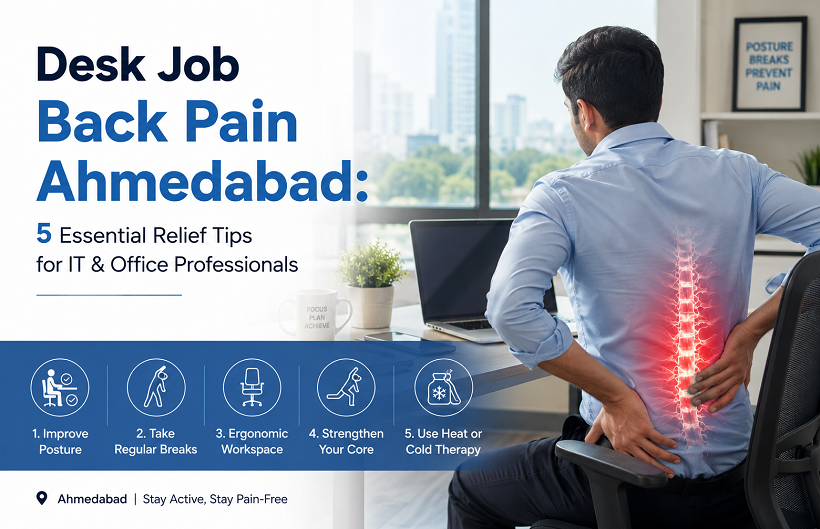
You sit down at 9 am feeling fine. By 1 pm your lower back has started to ache. By 6 pm your neck feels locked and your shoulders won’t relax. If this sounds familiar, you’re dealing with desk job back pain, and you’re far from alone.
Ahmedabad’s IT parks, corporate offices, and GIFT City workforce have grown fast, and so has the number of professionals coming into the clinic with the same complaint: pain that started small and slowly became part of the workday. As an orthopaedic surgeon in Ahmedabad, we see this pattern constantly, and the good news is that most desk job back pain is preventable once you understand what’s actually causing it.
Why Desk Job Back Pain Ahmedabad Professionals Report Is So Common
The human spine is built to move. Sitting for 8 to 10 hours a day, often hunched toward a screen, puts sustained pressure on the lower back discs and pulls the neck out of its natural alignment. Add a laptop placed too low, a chair with no lumbar support, and back-to-back meetings with no movement breaks, and the strain adds up fast.
This isn’t just discomfort. Prolonged poor posture gradually weakens the muscles that support your spine, so the same amount of sitting causes more pain over time, not less. That’s why desk job back pain tends to get worse year over year rather than resolving on its own.
The Most Common Symptoms We See
Lower back stiffness and ache.
Usually worse by the afternoon and often improves temporarily when you stand up or walk around. This is one of the earliest signs of desk job back pain and the easiest to fix if caught early.
Neck and upper back tightness.
Caused by the head tilting forward toward a screen for hours, sometimes called “tech neck.” Over time, this can radiate into headaches and shoulder tension, a pattern related to what we’ve covered in our guide on common causes of lower back pain.
Shooting or radiating pain.
Pain that travels down one leg or arm, sometimes with tingling or numbness, can indicate nerve involvement and needs proper evaluation rather than just a change in chair.
Reduced flexibility.
Many professionals notice they can no longer touch their toes comfortably or twist their torso without discomfort, a sign the supporting muscles have weakened from prolonged inactivity.
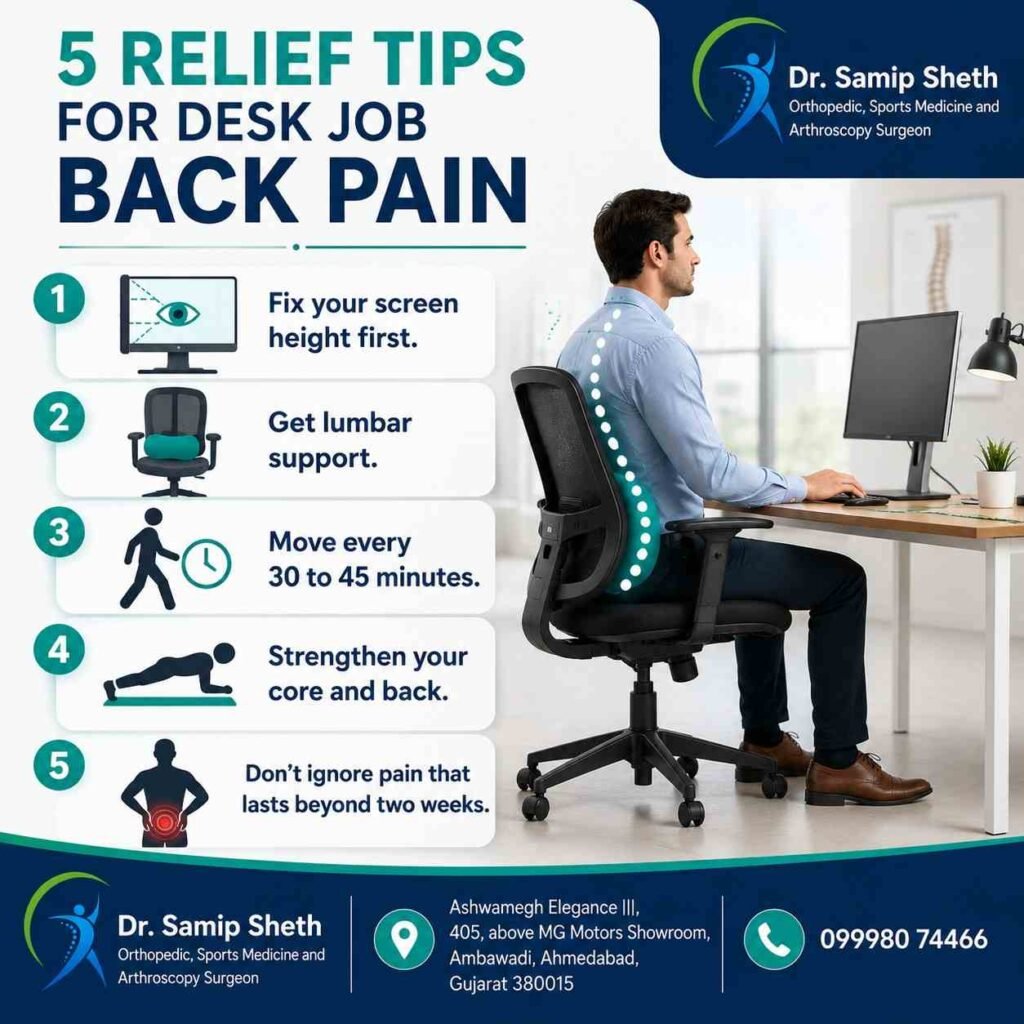
5 Relief Tips for Desk Job Back Pain
- Fix your screen height first. Your monitor should sit at eye level so you’re not tilting your neck down or up for hours at a time. This single change resolves a surprising amount of neck-related desk job back pain on its own.
- Get lumbar support, not just a “good chair.” The chair itself matters less than whether your lower back is supported in its natural curve. A rolled towel or a proper lumbar cushion works if a new chair isn’t an option right away.
- Move every 30 to 45 minutes. Set a reminder if you need to. Even a two-minute walk to refill water resets the pressure on your spinal discs and prevents the stiffness from building up across the day.
- Strengthen your core and back muscles. A strong core takes pressure off the spine during sitting. Our guide on spine strengthening exercises covers simple movements you can build into a daily routine.
- Don’t ignore pain that lasts beyond two weeks. Occasional stiffness is normal. Pain that persists, worsens, or starts radiating down a limb is your body telling you it needs proper treatment, not just a better chair.
When Desk Job Back Pain Needs a Doctor, Not Just Stretching
Most desk-related back pain responds well to posture correction, movement, and strengthening. See a specialist if you notice:
- Pain lasting more than two weeks despite rest and stretching
- Numbness, tingling, or weakness in an arm or leg
- Pain that disturbs your sleep
- Stiffness that limits basic movement like bending or turning
- Pain that started after a specific strain or injury, not gradual desk sitting
If any of these apply, it’s worth getting evaluated by Dr. Samip Sheth early, since chronic postural pain is far easier to treat before it becomes a long-term issue.
The Bottom Line
Desk job back pain doesn’t have to be an accepted part of working in an office or IT role. Small, consistent changes such as screen height, lumbar support, movement breaks, and core strength can prevent most cases entirely, and catching persistent pain early makes treatment far simpler.
If your back or neck pain isn’t improving with these changes, contact us or chat with us on WhatsApp to book a consultation and get a proper evaluation.
Expert Orthopedic Care for Every Step You Take
Whether you’re dealing with a sports injury, knee pain, shoulder pain, ligament tear, or persistent joint discomfort, early diagnosis can prevent long-term damage. Consult Dr. Samip Sheth, an experienced Orthopedic and Sports Injury Specialist in Ahmedabad, for expert evaluation and personalized treatment.
Frequently Asked Questions
Q: Is desk job back pain a sign of something serious?
A: Usually not. Most cases are muscular and related to posture and inactivity. However, pain that radiates, causes numbness, or doesn’t improve with basic changes should be checked to rule out disc-related issues.
Q: Can a standing desk fix desk job back pain?
A: It can help by breaking up long sitting periods, but standing all day with poor posture causes its own strain. Alternating between sitting and standing, with good posture in both, works best.
Q: How long does it take for posture-related back pain to improve?
A: Mild cases often improve within 2 to 3 weeks of consistent posture correction, movement breaks, and strengthening exercises. More persistent pain may need physiotherapy or a clinical evaluation.
Q: Should I see an orthopaedic doctor or a physiotherapist first?
A: For pain that’s new, mild, and clearly linked to sitting habits, physiotherapy is often a good starting point. If pain is severe, radiating, or has lasted more than two weeks, an orthopaedic evaluation first is the safer route.
Q: Does an ergonomic chair alone solve the problem?
A: No. A good chair helps, but it works best combined with correct screen height, regular movement, and core strengthening. Relying on the chair alone rarely resolves chronic desk job back pain.
Q: Can desk job back pain lead to a slipped disc later in life?
A: Prolonged poor posture and weak core muscles do increase long-term spine strain, which can contribute to disc issues over years. Addressing the pain early significantly lowers that risk.
Disclaimer: This blog is for informational purposes only and does not constitute medical advice. Please consult Dr. Samip Sheth or a qualified orthopedic specialist for diagnosis and treatment tailored to your condition.