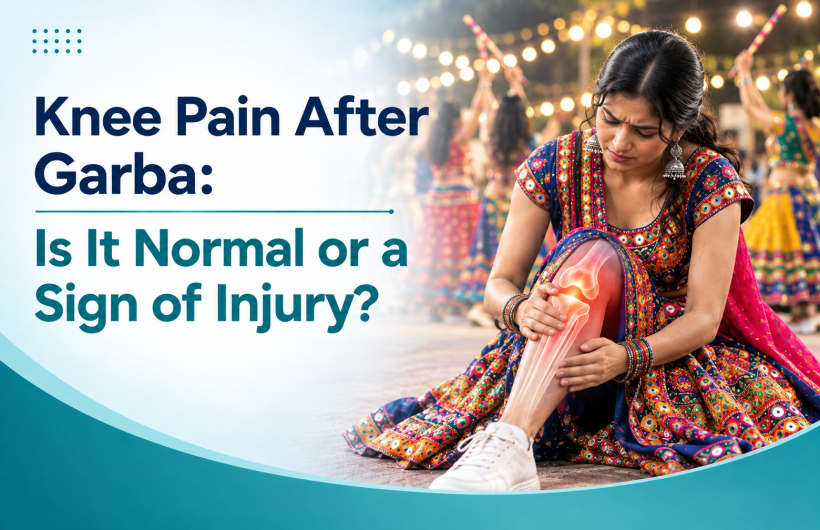
Your legs ache after a long Garba night, and now even the stairs make your knee complain. Mild soreness for a day or two is common, but sharp pain, swelling or a knee that gives way is not. This guide explains knee pain after Garba in plain words, so you can tell tired muscles from a real injury. You will also learn what to do at home and when to stop waiting. If the pain stays, a joint pain doctor in Ahmedabad can check your knee properly.
Is Knee Pain After Garba Normal?
Yes, mild knee pain after Garba is common, and it usually fades within two to three days. Garba keeps you on your feet for hours, with constant bending, spinning and stepping. Your thigh and calf muscles get tired, and tired muscles ache the next day. This is simple muscle soreness, and it does not mean your knee is damaged.
Normal soreness usually looks like this:
- A dull, achy feeling in the thighs or around both knees
- Stiffness when you first get up that eases after a few minutes of walking
- Little or no swelling
- A knee that feels steady when you stand and walk
Knee pain after Garba that fits this list can usually be managed at home with rest and light movement.
What Are the Signs That Knee Pain After Garba Is a Real Injury?
It is more likely an injury when the pain is sharp, sits in one spot, or started with a twist or a pop. Watch for these warning signs:
- Sharp pain on the inner or outer side of one knee
- Swelling that appears within a few hours
- A pop or tearing feeling at the moment you turned
- A knee that gives way or feels loose
- Locking or catching, or you cannot fully straighten the knee
- Trouble putting weight on the leg
- Pain that gets worse each day instead of better
Quick swelling often means something inside the knee was hurt, such as a ligament or the meniscus. The meniscus is the cushion between your thigh bone and shin bone. A catching or locking feeling can point to a meniscus tear. Nobody can name the exact injury without an examination, so please do not guess.
Why Does Garba Put So Much Strain on Your Knees?
The main reason is twisting. When you spin or turn while your foot stays planted, your thigh bone rotates over your shin bone, and your knee takes the force. Garba and Dandiya repeat this movement hundreds of times in one night.
Other things add to the strain:
- Nine nights in a row with little time to recover
- Hard, uneven or slippery ground at many venues
- Footwear with poor grip, or dancing barefoot
- Weak thigh and hip muscles after a year of low activity
- Extra body weight, which adds load to the knee with every step
When your muscles are tired, they protect the joint less, so a small slip can turn into a twist injury.
What Should You Do in the First 48 Hours?
Rest the knee, ice it, and skip dancing until the pain is clearly getting better. This routine helps most mild knee problems:
- Rest: Stay off the leg as much as you can, and skip the next Garba night if needed.
- Ice: Hold an ice pack wrapped in a thin cloth on the knee for 15 to 20 minutes, a few times a day.
- Compress: Use a snug elastic bandage, and loosen it if you feel numbness or tingling.
- Elevate: Keep the leg raised above heart level when you sit or lie down.
- Move gently: Once the sharp pain eases, bend and straighten the knee slowly and take short walks.
Avoid heat packs and deep massage in the first two days, because they can increase swelling. Ask a doctor or pharmacist before you take any painkiller. Ankle and heel problems also show up during Navratri, and our guide on Garba injury treatment Ahmedabad dancers can follow covers them. Knee pain after Garba that does not improve with this routine needs a proper check.
When Should You See an Orthopedic Doctor?
See a doctor the same day if you cannot put weight on the leg, your knee is locked, the swelling is large, the knee looks out of shape, or your foot feels numb or cold. These signs can mean a serious ligament or bone injury.
Book a visit within a few days if the pain lasts longer than three to five days, comes back every night, or wakes you from sleep. People with arthritis, an old ACL injury or a knee replacement should be extra careful, because a sudden flare after dancing deserves a check. Early care keeps a small problem from growing, and it is far easier than treating a tear that was ignored for months.
How Is Knee Pain After Garba Diagnosed and Treated?
A doctor first asks how the pain started, then checks swelling, movement and stability. An X-ray shows whether a bone is hurt. An MRI is used only when a ligament or meniscus tear is likely.
Dr. Samip Sheth treats sports injuries and performs knee arthroscopy at Marengo CIMS Hospital and sees patients at his Ambawadi clinic. Treatment depends on the injury. Most cases need rest, a knee support and physiotherapy to rebuild thigh strength. Keyhole surgery (arthroscopy) is considered only when a tear causes locking or repeated giving way and other treatment has not worked.
Recovery time varies. Mild strains often improve in a couple of weeks, while ligament and meniscus injuries can take longer, sometimes several months with proper rehab. A clear plan matters more than a quick fix.
When Is It Safe to Dance Garba Again?
You can usually return when you walk without a limp, fully bend and straighten the knee, climb stairs without pain, and see no swelling. Before you go back, make sure your knee pain after Garba has settled completely, not just eased for a few hours.
Start with 15 to 20 minutes of slow steps, then build up over several days. Stop right away if sharp pain, swelling or a giving-way feeling returns. Once the swelling is gone, you can add these home remedies for knee pain alongside your rehab.
How Can You Prevent Knee Pain After Garba?
A few habits lower your risk through all nine nights:
- Warm up for 5 to 10 minutes with leg swings, marching and gentle knee bends.
- Strengthen your legs ahead of time with squats, calf raises and glute bridges.
- Check the ground for stones, wet patches and loose mats.
- Wear flat, grippy footwear where it is allowed.
- Spin slowly and avoid sharp twists on a planted foot.
- Pace yourself with water breaks, and rest one night if your legs feel heavy.
Stretch your thighs and calves after dancing. If you are above 40, have arthritis, or have hurt your knee before, keep your steps gentle.
Not sure whether your pain is normal? Send a short message on WhatsApp describing your symptoms, and our team will guide you on the next step.
Conclusion
That ache in your knee the morning after Garba can be ordinary tiredness, or it can be your knee asking for help. If the pain is dull, on both sides and fading, rest and ice are usually enough. If it is sharp, swollen or unstable, knee pain after Garba deserves a proper check before the next dance night. If you are unsure, contact us to book a visit with Dr. Samip Sheth at our Ambawadi, Ahmedabad clinic, and we will plan your care for knee pain after Garba around your exact injury.
Expert Orthopedic Care for Every Step You Take
Whether you’re dealing with a sports injury, knee pain, shoulder pain, ligament tear, or persistent joint discomfort, early diagnosis can prevent long-term damage. Consult Dr. Samip Sheth, an experienced Orthopedic and Sports Injury Specialist in Ahmedabad, for expert evaluation and personalized treatment.
Frequently Asked Questions
Is knee pain after Garba normal on the second day?
Mild soreness on the second day is common. It should be easing, not getting worse. If it is sharper or more swollen than on day one, get it checked.
Should I use ice or heat for knee pain after Garba?
Use ice for the first 48 hours to reduce swelling. Gentle heat can help stiff muscles later, once the swelling is gone.
Can I dance Garba with mild knee pain?
If your knee is swollen, sharp or unstable, rest it. If it is only mild muscle soreness, short and slow dancing may be fine. Stop at the first sharp twinge.
How long does knee pain after Garba last?
Simple muscle soreness fades in two to three days. A sprain or tear takes longer, and any pain that lasts beyond three to five days should be examined.
Do I need an MRI for a twisted knee?
Not always. A doctor will examine the knee first and suggest an MRI only if a ligament or meniscus tear is likely.
Can people with knee arthritis or a knee replacement play Garba?
Many can dance gently once they have recovered well. Avoid sharp twisting, and ask your surgeon before you start.
Medical disclaimer: This blog is for general information only and is not medical advice. Every injury is different, so please see a qualified doctor for a diagnosis and treatment plan that fits you.