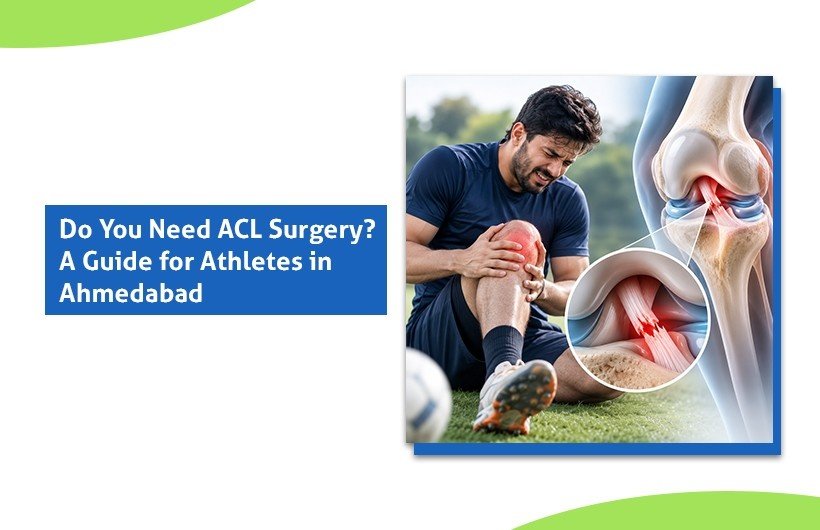
Your knee gave way mid-pivot, you heard or felt a pop, and now, a swollen knee and an MRI report later, someone has told you it’s an ACL Tear. The next question almost every athlete asks is the same one: do I need surgery?
There isn’t a single answer that applies to everyone, and that’s the truth most content on this topic skips past. As a sports injury specialist in Ahmedabad, the decision I walk patients through depends less on the MRI alone and more on what you play, how you play it, and how unstable your knee feels day to day.
This ACL Tear Treatment in Ahmedabad guide walks through how that decision genuinely gets made, not a sales pitch for surgery, and not a reason to avoid it either.
What Exactly Happens When You Tear Your ACL?
The ACL (anterior cruciate ligament) is one of the main stabilizers connecting your thigh bone to your shin bone, and once it’s torn, it doesn’t heal back on its own the way a muscle strain does.
Unlike a sprained ligament that can repair itself with rest, the ACL has poor blood supply, so a full tear generally stays torn unless surgically reconstructed. What varies enormously from person to person is how much that matters functionally, some people’s knees stay reasonably stable without an intact ACL; others feel their knee buckle with almost every pivot or sudden stop.
That difference is exactly why “surgery or not” isn’t a yes/no answer from the MRI report alone.
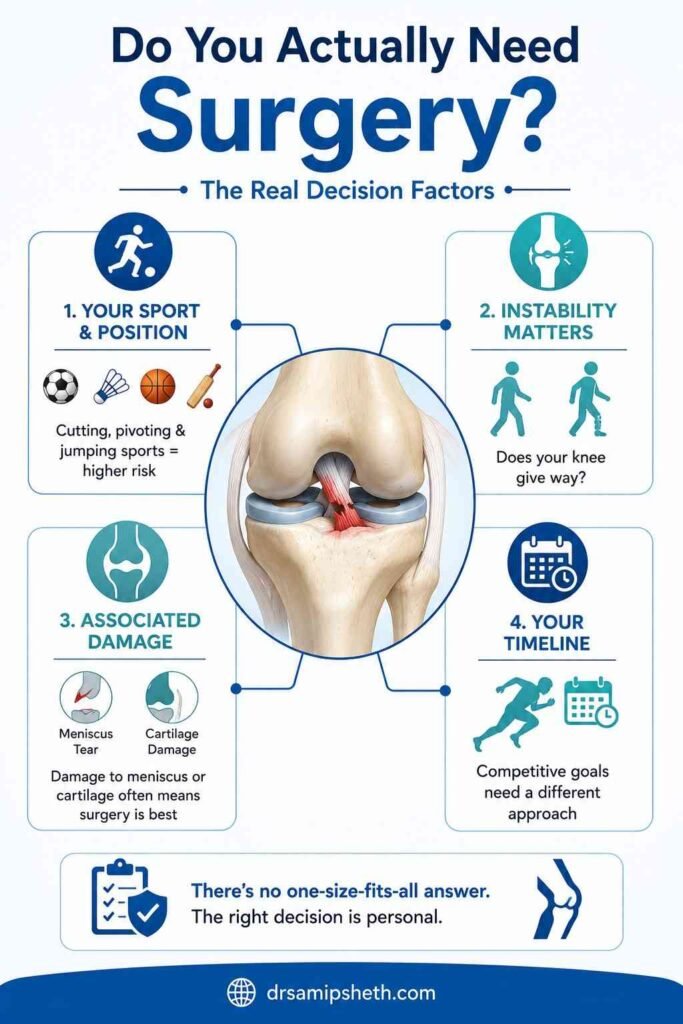
Do You Actually Need Surgery? The Real Decision Factors
Contrary to what a lot of clinic websites imply, surgery isn’t automatic just because the ACL is torn. Here’s what genuinely drives the decision.
Your sport and position matter more than your age.
Cutting, pivoting, and jumping sports, football, badminton, basketball, cricket fielding, put far more rotational demand on the knee than straight-line activities like cycling or swimming. An athlete who needs to change direction suddenly is a much stronger surgical candidate than someone whose activity is mostly linear.
Instability is the real test, not the tear itself.
Some patients with a confirmed ACL tear on MRI report their knee feels stable in daily life and even during modified training. Others feel their knee give way just walking on uneven ground. The second group needs surgery far more urgently than the MRI grade alone would suggest.
Associated damage changes the calculus.
An ACL tear rarely travels alone; meniscus tears and cartilage damage are common companions. If there’s meniscus damage that needs repair, that often pushes the decision toward surgery, since an unstable knee accelerates further meniscus wear.
Your timeline matters.
A competitive athlete with a season or a selection trial coming up faces a very different conversation than someone who plays badminton socially on weekends.
Can an ACL Tear Heal Without Surgery?
The ligament itself won’t heal, but a knee can sometimes function well enough without one, depending on the demands placed on it.
This is the nuance most patients aren’t told clearly. “Non-surgical management” doesn’t mean the ACL grows back, it means building enough strength in the surrounding muscles, particularly the hamstrings and quadriceps, that they compensate for the missing stability. For lower-demand activities and patients willing to modify their sport, this genuinely works for a meaningful subset of people. For pivot-heavy competitive athletes, it usually isn’t enough on its own, and delaying surgery in that group often just means more meniscus and cartilage damage by the time they do have it done.
What Does ACL Surgery Actually Involve?
ACL reconstruction is typically done arthroscopically, using a graft (commonly your own hamstring or patellar tendon tissue) to rebuild the ligament, through small incisions rather than open surgery.
It’s a well-established, minimally invasive procedure, not the major open surgery many patients’ picture. Recovery isn’t instant, though, return to full competitive sport is generally a matter of months, not weeks, and follows a structured rehabilitation timeline rather than a fixed date.
What Does Recovery and Return to Sport Actually Look Like?
Recovery happens in stages, not as a single “recovered” moment, and rushing back early is the single biggest cause of re-injury.
Early weeks focus on reducing swelling and regaining range of motion. This moves into progressive strengthening, then sport-specific drills, and only later, controlled return-to-play testing. Athletes who return to cutting and pivoting sports before their strength and confidence genuinely catch up are at meaningfully higher risk of re-tearing the same knee or injuring the other one, which is why the timeline is built around functional milestones, not just a calendar date.
ACL Tear vs. Meniscus Tear: How Are They Different?
They’re often confused because both cause knee pain and swelling after a twisting injury, but they’re different structures with different treatment paths.
The ACL stabilizes the knee against pivoting forces, while the meniscus cushions the joint between the thigh and shin bones. It’s common to injure both at once in the same twisting incident, which is exactly why a proper MRI-based evaluation matters before deciding on treatment, treating one and missing the other leads to an incomplete recovery. We go into more detail on rebuilding strength safely after any sports injury in our guide on sports injury specialist in Ahmedabad-recommended comeback protocols.
Conclusion
An ACL tear diagnosis isn’t an automatic ticket to surgery, and it isn’t something to sit on indefinitely either. The right call depends on your sport, your knee’s actual stability, and what’s realistically at stake if you wait. That’s a conversation best had with a proper clinical exam and imaging in front of you, not a generic answer online.
If you’re an athlete weighing this decision right now, contact us to book an evaluation with Dr. Samip Sheth at our Ambawadi clinic or send a quick WhatsApp message if you just want to ask about your specific situation first.
Expert Orthopedic Care for Every Step You Take
Whether you’re dealing with a sports injury, knee pain, shoulder pain, ligament tear, or persistent joint discomfort, early diagnosis can prevent long-term damage. Consult Dr. Samip Sheth, an experienced Orthopedic and Sports Injury Specialist in Ahmedabad, for expert evaluation and personalized treatment.
Frequently Asked Questions
Q: How do I know if my ACL tear is serious enough to need surgery?
A: The clearest signal isn’t the MRI grade alone, it’s whether your knee feels unstable or gives way during daily activity or light training, combined with what sport you’re returning to.
Q: Can I go back to playing cricket or football without ACL surgery?
A: Some athletes manage recreational play with intensive strengthening and a knee brace, but competitive-level cutting and pivoting sports carry a meaningfully higher risk of re-injury and further joint damage without reconstruction.
Q: How long after ACL surgery can I return to competitive sport?
A: Most structured rehabilitation programs target somewhere in the range of 8 to 12 months for full competitive return, based on functional testing rather than time alone.
Q: Is ACL surgery painful, and how long is the hospital stay?
A: It’s typically a minimally invasive arthroscopic procedure with a short hospital stay, often one to two days, with manageable post-operative pain controlled through standard pain management protocols.
Q: What happens if I delay ACL surgery for a few months?
A: For pivot-heavy athletes with an unstable knee, delaying surgery increases the risk of additional meniscus or cartilage damage from ongoing instability, which is why timely evaluation matters even if you’re not ready to decide on surgery yet.
Q: Do younger athletes recover faster from ACL reconstruction than older ones?
A: Age plays a smaller role than overall fitness, muscle strength going into surgery, and how closely the rehabilitation program is followed.
This article is for informational purposes only and does not constitute medical advice. Please consult Dr. Samip Sheth or a qualified orthopaedics specialist for diagnosis and treatment specific to your condition.