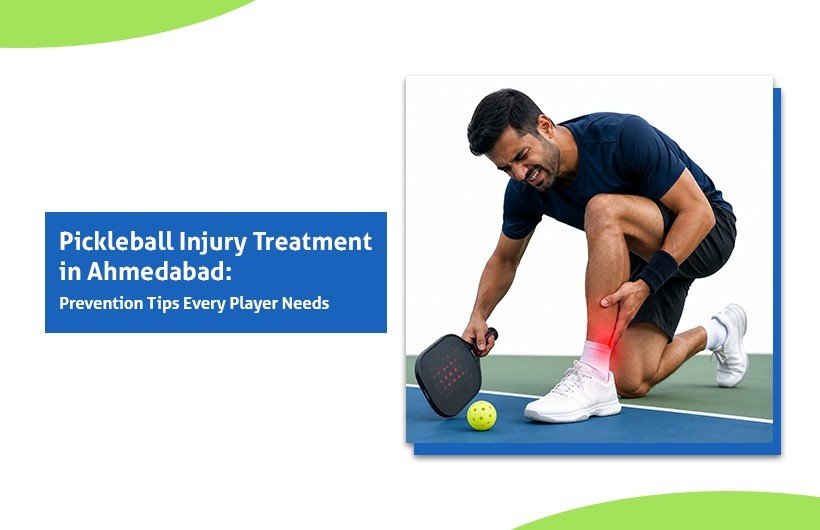
Ahmedabad has over 500 pickleball courts now, and if you’ve picked up a paddle in the last year, you’re part of one of the fastest-growing sports communities in the city. It’s also bringing a steady stream of new patients into orthopedic clinics — and most of them are surprised it happened to them.
Pickleball looks gentler than tennis or badminton, and in many ways it is. But the sudden stops, quick direction changes, and overhead paddle motion put real stress on joints that haven’t been conditioned for it, especially if you’re returning to sport after years away. As a sports injury specialist in Ahmedabad, I’ve seen the pattern repeat: enthusiastic new players, minimal warm-up, and an injury within the first few weeks of regular play.
Here’s what causes pickleball injuries, who’s most at risk, and what to do if it’s already happened to you.
Why Does Pickleball Cause So Many Injuries?
Pickleball injuries happen because the sport combines sudden, high-intensity movements with a player base that’s often not conditioned for them.
National injury data backs this up clearly: soft tissue strains and sprains make up nearly half of all pickleball injuries, with fractures and arthritis-related pain becoming more common in players over 60. The sport’s quick lateral shuffles, sudden stops at the “kitchen line,” and repetitive overhead and wrist motion during serves and dinks all load joints in ways many players — especially those returning to sport after a long gap — simply aren’t prepared for.
Unlike a sport you train into gradually, pickleball’s low learning curve means people go from zero to playing competitively within a few sessions, without building the surrounding strength and mobility first.
What Are the Most Common Pickleball Injuries?
The most frequently reported pickleball injuries are ankle sprains, rotator cuff strain, tennis elbow, wrist fractures, and lower back strain.
Ankle sprains happen from the sport’s constant side-to-side shuffling and quick direction changes, especially on outdoor courts with uneven surfaces.
Rotator cuff and shoulder strain comes from repetitive overhead serves and smashes, particularly in players who haven’t done any shoulder conditioning beforehand. If shoulder pain lingers after play, it’s worth understanding your risk further — our guide on shoulder pain specialist Ahmedabad-recommended care covers this in more depth.
Tennis elbow (lateral epicondylitis) develops from the repeated wrist-snap motion of paddle shots, especially with poor technique or an ill-fitted paddle grip.
Wrist and hand fractures are more common in falls, particularly among players over 50, since an instinctive hand-out-to-brace-a-fall reaction puts direct impact force through the wrist.
Lower back strain comes from the bent-knee, low-stance position pickleball demands, especially in players who don’t have strong core or hip mobility going in.
Who Is Most at Risk?
Two groups face the highest injury risk: complete beginners in their first few weeks of play, and players over 50 picking the sport back up after years of inactivity.
Beginners get hurt from unfamiliar movement patterns and poor technique before their body adapts. Older, returning players face a different risk — bone density, joint cartilage, and reaction time have all changed since they were last regularly active, even if their enthusiasm hasn’t. National injury data shows most pickleball injuries occur in players over 50, with women at meaningfully higher risk of fractures specifically.
Neither group needs to stop playing — but both need to approach the first several weeks differently than an experienced athlete would.
How Can You Prevent Pickleball Injuries?
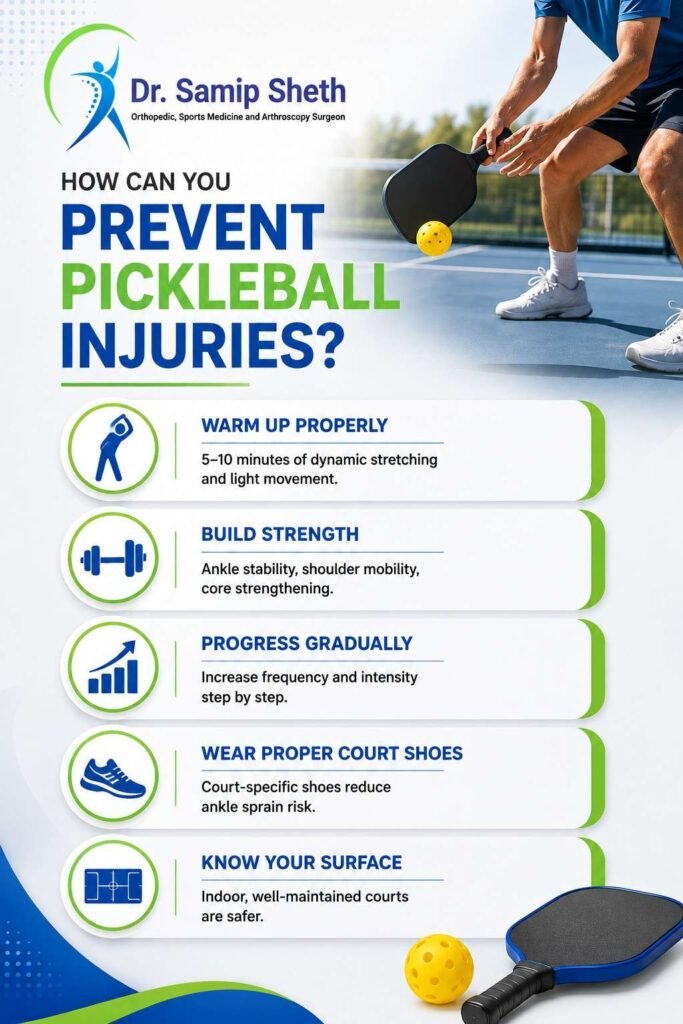
Most pickleball injuries are genuinely preventable with a few consistent habits before and during play.
Warm up properly, every time. Five to ten minutes of dynamic stretching and light movement before your first serve makes a real difference, especially for shoulders, ankles, and the lower back.
Build strength outside the court. Basic conditioning — ankle stability work, shoulder mobility exercises, core strengthening — reduces injury risk far more than any amount of on-court practice alone.
Progress gradually. Playing three intense sessions in your first week is a common mistake. Give your body time to adapt to a new movement pattern before increasing frequency or intensity.
Wear proper court shoes. Running shoes don’t provide the lateral ankle support pickleball’s side-to-side movement demands. Court-specific shoes reduce ankle sprain risk meaningfully.
Know your surface. Outdoor courts with uneven ground carry higher fall and ankle-injury risk than indoor, well-maintained courts.
Don’t play through pain. A minor ache that gets ignored for a few more sessions is how a manageable strain becomes a real injury. If you’ve had a previous injury and are getting back into sport, our guide on sports injury specialist Ahmedabad-recommended comeback strategies is worth reading before you resume play.
When Should You See a Doctor for a Pickleball Injury?
See a doctor if pain persists more than a few days, if there’s visible swelling or bruising, or if a joint feels unstable or won’t bear weight normally.
Minor soreness after a new activity is normal and usually settles with rest and basic care. What’s not normal is pain that doesn’t improve after a few days of rest, swelling that doesn’t go down, a joint that feels loose or gives way, or any injury where you heard a pop or crack now it happened. Fractures can be mistaken for “just a bad sprain” without proper imaging, especially in wrist injuries from falls.
Conclusion
Pickleball’s boom in Ahmedabad isn’t slowing down, and there’s no reason it should — it’s a genuinely fun, accessible sport for almost any age. But a little preparation goes a long way toward making sure you’re playing for years, not sidelined after a few weeks.
If you’re dealing with a pickleball injury that isn’t improving or want a proper movement assessment before you ramp up your play, contact us to book a consultation with Dr. Samip Sheth at our Ambawadi clinic or send a quick WhatsApp message to ask first.
Expert Orthopedic Care for Every Step You Take
Whether you’re dealing with a sports injury, knee pain, shoulder pain, ligament tear, or persistent joint discomfort, early diagnosis can prevent long-term damage. Consult Dr. Samip Sheth, an experienced Orthopedic and Sports Injury Specialist in Ahmedabad, for expert evaluation and personalized treatment.
Frequently Asked Questions
Q: Is pickleball harder on the body than tennis?
A: Not necessarily harder overall, but different — pickleball’s smaller court and quicker exchanges mean more sudden stops and direction changes packed into less time, which is why conditioning matters even for experienced racquet-sport players switching over.
Q: I’m over 50 and just started playing — should I be worried?
A: Not worried, but appropriately cautious: build in a proper warm-up, start with fewer sessions per week, and pay attention to any joint pain that doesn’t resolve within a couple of days rather than playing through it.
Q: Can I keep playing pickleball with mild knee arthritis?
A: Many players with mild arthritis do continue playing with modifications — proper footwear, strength conditioning, and moderated intensity — though it’s worth a proper evaluation first to understand your specific joint condition.
Q: How long does a typical ankle sprain from pickleball take to heal?
A: Mild sprains often improve within one to two weeks with rest and basic care, while more significant sprains can take four to six weeks and may need a structured rehabilitation plan.
Q: Should I get an X-ray after a fall, even if I can still move my wrist?
A: Yes — being able to move a joint doesn’t rule out a fracture, and wrist fractures from falls are common enough in pickleball that it’s worth confirming with imaging rather than assuming it’s just a sprain.
This article is for informational purposes only and does not constitute medical advice. Please consult Dr. Samip Sheth or a qualified orthopedic specialist for diagnosis and treatment specific to your condition.