
If your knees, hips, or fingers start aching the moment the first monsoon clouds roll over Ahmedabad, you’re not imagining it. It’s one of the most common complaints we hear at the clinic every June through September, and there’s a real physiological reason behind it.
This isn’t just “old joints reacting to weather.” For people managing osteoarthritis or a previous joint injury, falling barometric pressure and rising humidity genuinely change how your joints feel, and understanding why can help you manage it better this season. Many of the patients who come to see the Orthopaedic surgeon in Ahmedabad at our Ahmedabad clinic each monsoon is looking for exactly this kind of clarity.
We treat a steady stream of monsoon flare-ups every year, and this guide covers what’s happening in your joint pain in monsoon Ahmedabad, what you can do about it starting today, and when rain-season discomfort is a sign of something that needs a proper evaluation.
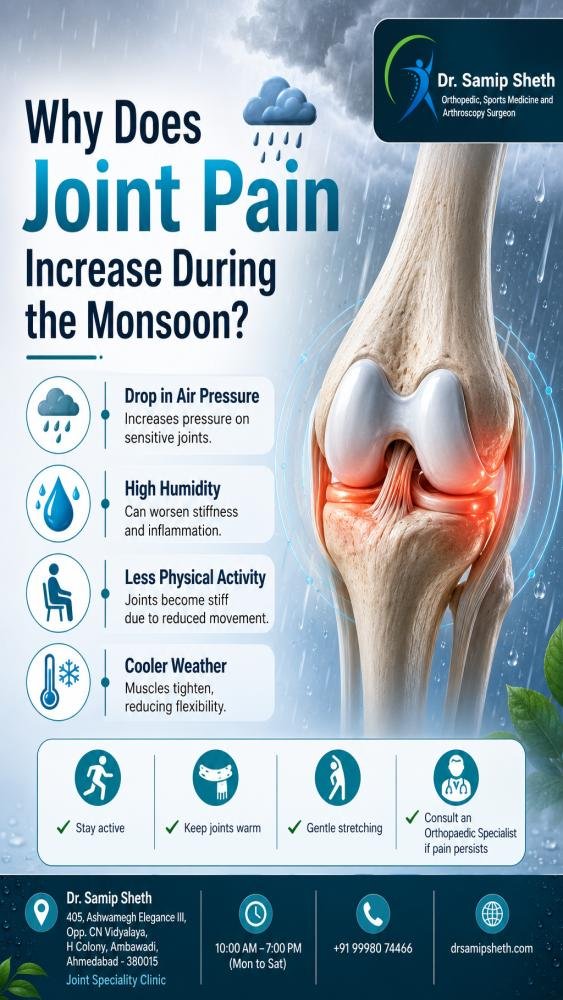
Why Does Joint Pain Increase During the Monsoon?
The short answer: falling air pressure lets your joint tissues expand slightly, and that expansion presses on nerves that are already sensitized by arthritis or old injuries.
Here’s the fuller picture. Atmospheric pressure drops before and during rain. Your joints, particularly ones with worn cartilage or scar tissue from a past injury, have a synovial capsule filled with fluid and gas. When outside pressure drops, tissues inside that capsule expand very slightly. In a healthy joint, this goes unnoticed. In a joint with arthritis, that small expansion pushes against already-irritated nerve endings.
Humidity adds to this. Thicker, moisture-laden air is associated with increased pain reports in several studies of arthritis patients, though researchers haven’t fully settled why. Reduced sunlight during Ahmedabad’s rainy months lowers Vitamin D synthesis too, and low Vitamin D is independently linked to more joint pain and stiffness.
Cold, damp air, even a mild dip in temperature during heavy rain, can also cause the fluid inside joints to thicken slightly, making movement feel stiffer first thing in the morning.
Is This Just Old Wear-and-Tear, or Should I Be Concerned?
Most monsoon joint pain is a flare-up of an existing condition, not a new injury. But the pattern matters.
If your pain follows the weather closely, worse before and during rain, better on clear days, that’s typical of osteoarthritis or an old injury reacting to pressure changes. This is uncomfortable but not usually dangerous on its own.
What’s different is when the pain doesn’t follow that pattern. Constant swelling that doesn’t go down between rain spells, pain that wakes you at night, or a joint that’s warm to the touch and visibly swollen are signs of something that needs direct evaluation, possibly an active inflammatory flare, an infection, or joint damage that’s progressed further than a simple weather reaction would explain.
What Actually Helps During Monsoon Flare-Ups
You don’t have to just wait out the season. A few adjustments make a real difference for most patients.
Keep moving, gently.
It’s tempting to rest a painful joint completely, but inactivity stiffens joints further. Short, low-impact sessions, walking indoors, gentle stretching, or a stationary cycle, keep synovial fluid moving and reduce stiffness far more than complete rest does.
Stay warm and dry.
Damp clothing and cold, air-conditioned rooms both worsen stiffness. Keep affected joints covered, and if you use a compression sleeve or knee support, monsoon is when it earns its keep.
Watch your Vitamin D.
With less sun exposure during the rains, ask your doctor whether a supplement makes sense for you, especially if you already have diagnosed osteoarthritis.
Manage weight through the season.
It’s easy to become more sedentary when it’s raining, but even a small weight gain adds measurable load to knee and hip joints. We’ve written in more detail about this in our guide to joint pain doctor in Ahmedabad advice on weight and joint strain.
Use heat, not just ice.
For monsoon stiffness specifically (as opposed to an acute injury), a warm compress or warm water soak often works better than ice, since the goal is to loosen tissue rather than reduce acute swelling.
Does Getting Wet in the Rain Actually Cause Arthritis?
No, getting caught in the rain does not cause arthritis. This is one of the most persistent myths we hear from patients and their families every monsoon.
Arthritis develops from cartilage wear, autoimmune processes, injury, or genetic factors over years. Rain exposure doesn’t create these conditions. What rain and the accompanying pressure and humidity changes do is make an already-existing condition more noticeable and uncomfortable. If you don’t have arthritis or a prior joint injury, monsoon weather on its own won’t give you one.
When Should You See a Doctor for Monsoon Joint Pain?
Most seasonal flare-ups can be managed at home, but you should get it checked if you notice any of the following:
- Swelling that doesn’t reduce within a few days of rest and home care
- Pain severe enough to limit walking or daily tasks
- A joint that feels warm, red, or looks visibly swollen
- Pain that’s new this year and wasn’t there in previous monsoons
- Symptoms that persist well after the rains stop
At our clinic, we start with a straightforward clinical exam and, where needed, imaging to see exactly what’s driving the pain, since monsoon discomfort in an already-damaged joint can sometimes point to a stage of arthritis where non-surgical management alone isn’t enough anymore.
What Home Remedies Are Worth Trying First?
For mild, weather-linked discomfort, simple measures go a long way before you need medical treatment. Warm compresses, gentle daily movement, staying hydrated, and maintaining a consistent sleep schedule all help reduce how much the pressure and humidity swings affect you. We cover a fuller set of these in our piece on knee pain specialist in Ahmedabad-recommended home care, which applies well to monsoon flare-ups too.
If home care isn’t cutting it after a week or two, that’s usually the signal to get an actual evaluation rather than waiting out the rest of the season uncomfortably.
Conclusion
Monsoon joint pain is real, it’s explainable, and for most people, it’s manageable with a few season-specific adjustments rather than a complete lifestyle overhaul. But if your pain is getting worse year over year, or home care isn’t touching it anymore, that’s a different conversation, one worth having with an orthopaedic surgeon in Ahmedabad before another monsoon goes by the same way.
If the rains have you dreading every step this season, contact us to book a consultation with Dr. Samip Sheth at our Ahmedabad clinic, or WhatsApp us directly to ask a quick question first.
Expert Orthopedic Care for Every Step You Take
Whether you’re dealing with a sports injury, knee pain, shoulder pain, ligament tear, or persistent joint discomfort, early diagnosis can prevent long-term damage. Consult Dr. Samip Sheth, an experienced Orthopedic and Sports Injury Specialist in Ahmedabad, for expert evaluation and personalized treatment.
Frequently Asked Questions
Q: Why do my knees hurt more specifically right before it rains, not during?
A: Barometric pressure typically starts dropping hours before rainfall begins, and that’s when the pressure-related tissue expansion in an arthritic joint start. By the time it’s raining, pressure has often stabilized somewhat, which is why many patients notice the ache easing slightly once the rain is fully underway.
Q: I don’t have arthritis, why does my old ankle injury still ache in the monsoon?
A: Old injuries often leave subtle scar tissue or minor cartilage changes even after they’ve healed, which can make that joint sensitive to the same pressure and humidity shifts that affect arthritic joints.
Q: Can diet help with monsoon joint pain?
A: An anti-inflammatory diet, more omega-3s, less processed sugar and fried food, won’t eliminate weather-related flare-ups, but many patients report it takes the edge off overall joint sensitivity during the season.
Q: Is it safe to exercise if my joints are already aching from the weather?
A: Yes, gentle low-impact movement is usually recommended over rest, though you should scale back intensity, not stop entirely, unless there’s swelling or sharp pain.
Q: How long does a typical monsoon flare-up last?
A: For most patients with mild-to-moderate osteoarthritis, discomfort tracks the weather day to day and settles once air pressure stabilizes, though this can vary from a few hours to a few days after a significant weather shift.
Q: Should elderly family members be more cautious during monsoon joint pain?
A: Yes, older adults with existing joint conditions tend to feel weather-related pain more intensely and are also more prone to reduced mobility and fall risk when stiffness sets in, so it’s worth checking in on them more closely this season.
This article is for informational purposes only and does not constitute medical advice. Please consult Dr. Samip Sheth or a qualified orthopaedics specialist for diagnosis and treatment specific to your condition.