Dr. Samip Sheth, Orthopedic Surgeon, Ambawadi, Ahmedabad
If your MRI shows a torn meniscus and your doctor has mentioned surgery, the next question is which operation you need. The common types of meniscus tear surgery are partial meniscectomy (trimming the torn part), meniscus repair (stitching it back together), meniscus root repair, and meniscus transplant in selected cases. Which one suits you depends on where the tear is, its pattern, your age and how active you are. As an orthopedic surgeon in Ahmedabad would tell you in clinic, no single meniscus tear surgery type is right for everyone, and many tears do not need an operation at all.
Why Does the Meniscus Matter Before You Choose Surgery?
You have two menisci in each knee, one on the inner side and one on the outer side. They are C-shaped pads of cartilage that sit between your thigh bone and shin bone. They absorb shock, spread load across the joint and help keep the knee stable.
This is why surgeons try to save as much meniscus as possible. Removing meniscus tissue can ease pain and locking, but a knee with less meniscus carries load differently, and that is linked to a higher risk of arthritis over the years.
Blood supply also decides what is possible. According to the American Academy of Orthopaedic Surgeons, the outer third of the meniscus has a rich blood supply, so tears there may heal or can often be repaired. The inner part has little blood supply, so tears there rarely heal on their own and are more often trimmed.
Meniscus Tear Surgery Types: Which One Fits Your Tear?
Here is the short version before we go through each one.
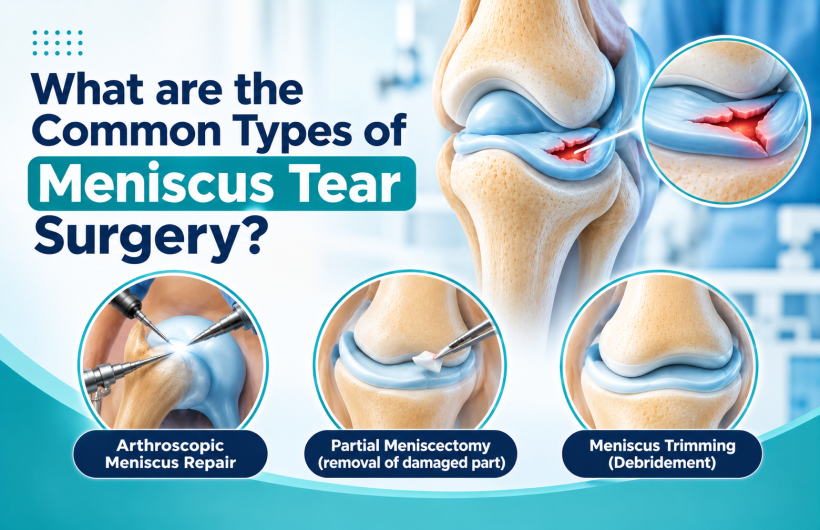
- Partial meniscectomy: the torn, unstable piece is trimmed away and the healthy rim is kept.
- Meniscus repair: the torn edges are stitched together so the meniscus can heal.
- Meniscus root repair: a torn attachment at the back of the meniscus is re-anchored to the bone.
- Total or subtotal meniscectomy: most or all of the meniscus is removed. This is now rare.
- Meniscus transplant: donor meniscus replaces a meniscus that has been lost, in carefully selected patients.
Almost all of these are done through keyhole (arthroscopic) surgery, with two or three small cuts around the knee.
1. Arthroscopic Partial Meniscectomy (Trimming)
This is the most common meniscus tear surgery. The surgeon passes a camera into the knee, looks at the tear directly and trims away only the damaged, unstable tissue with small instruments.
It suits tears in the inner, poorly supplied zone, frayed degenerative tears, and flap tears that catch in the joint and cause clicking or locking. The main advantage is a quicker recovery, because nothing has to heal. The trade-off is that the meniscus that remains is smaller.
2. Meniscus Repair (Stitching)
In a repair, the surgeon sutures the torn edges together so they can knit back. Repairs are described by where the stitches are placed: inside-out, outside-in or all-inside. Your surgeon chooses based on where the tear sits.
Repair is usually preferred for fresh tears in younger and active patients, especially longitudinal tears and bucket-handle tears in the well-supplied outer zone. It is often done together with an ACL reconstruction, because the healing environment in the knee tends to be better.
Recovery is slower than after trimming. The orthopaedic association guidance is clear on this: because the meniscus must heal back together, a repair takes longer to recover from than a meniscectomy. A repair can also fail, and some patients need another procedure later.
3. Meniscus Root Repair
The meniscus is anchored to the shin bone at its front and back ends, and these anchors are called roots. A root tear is serious, because the meniscus can no longer share load properly, even if the tear looks small on the scan.
In a root repair, the surgeon passes sutures through the torn root and secures them through a small tunnel in the bone, pulling the meniscus back to its original position. Surgeons increasingly prefer repair to trimming for root tears in suitable patients, because trimming does not restore the meniscus’s job.
4. Total or Subtotal Meniscectomy
Removing most of a meniscus was once common. Today it is reserved for tears so extensive that nothing can be saved. Because it changes how the joint carries load, surgeons avoid it where they can.
5. Meniscus Transplant (Allograft)
For a younger patient who has already lost most of a meniscus and still has pain in that part of the knee but little arthritis, a donor meniscus can be placed in the knee. This is a specialised procedure with strict selection criteria. It is not a routine option and is discussed only after a full assessment.
How Do Surgeons Decide Between Trimming and Repairing?
Your surgeon looks at several things together, and the MRI is only one of them. The final decision is often made during arthroscopy, when the meniscus can be seen and probed directly.
- Where the tear is: outer-zone tears can heal, inner-zone tears usually cannot.
- Tear pattern: a clean longitudinal or bucket-handle tear is more repairable than a shredded, degenerative one.
- Age and tissue quality: older, worn meniscus tissue often does not hold stitches or heal well.
- Activity goals: a 22-year-old cricketer and a 62-year-old retiree usually need different plans.
- Other injuries: a torn ACL changes the plan and often favours repair.
- Arthritis in the knee: if arthritis is already significant, trimming a tear may not relieve the pain you feel.
That last point surprises many patients. In older adults with degenerative tears, several randomized trials have found that a structured physiotherapy programme gave results comparable to keyhole trimming for many people. Surgery makes the most difference when there is a true mechanical problem, such as a knee that locks.
Do You Need Surgery for a Meniscus Tear at All?
Not always. Many small or degenerative tears settle with rest, physiotherapy and activity changes. For mild knee pain without locking, the measures in our guide to home remedies for knee pain can help with symptoms, although they will not repair a torn meniscus.
Book an assessment sooner if you notice any of these:
- Your knee locks or catches, and you cannot fully straighten it.
- The knee gives way when you walk, turn or climb stairs.
- Swelling keeps returning or does not settle after a few weeks.
- Pain stays on one side of the joint line and gets worse with twisting.
- You had a twisting injury during sport and could not continue playing.
What Does Recovery Look Like After Meniscus Surgery in Ahmedabad?
Recovery depends far more on the type of surgery than on the surgeon’s skill alone. These are typical ranges, and your own plan may differ.
After partial meniscectomy: most people walk the same day or the next day. Desk work is often possible within a week or two, and a return to sport usually follows over roughly four to six weeks, guided by swelling and strength.
After meniscus repair or root repair: you may need crutches and sometimes a brace for several weeks, with limits on how far the knee bends and how much weight goes through it. Return to running and sport commonly takes around four to six months.
Here is a point that matters in Gujarat. Many of us sit cross-legged on the floor, squat for prayers or use Indian-style toilets, and these positions bend the knee very deeply. Deep bending puts the most stress on the back of the meniscus, so after a repair you will usually be asked to avoid them for a period. Ask your surgeon exactly how long, and plan your home setup before surgery, for example a raised toilet seat and a chair for meals.
Dr. Samip Sheth performs knee arthroscopy as a visiting consultant at Marengo CIMS Hospital, and a good rehab plan is part of every treatment discussion. If you play cricket, run or dance Garba, our guide to sports injury recovery explains how return to play is usually staged.
What Are the Risks of Meniscus Tear Surgery?
Keyhole knee surgery is generally safe, and serious complications are uncommon. Still, you should know what they are:
- Stiffness or swelling that lasts longer than expected
- Infection
- A blood clot in the leg (deep vein thrombosis)
- Nerve irritation near the incision, which can cause a patch of numbness
- Ongoing pain, especially if arthritis was already present
- Re-tear or failure to heal after a repair
Surgery cannot undo age-related wear in the knee. It treats a torn meniscus, and an honest conversation before the operation should cover what it can and cannot do for your particular knee.
Conclusion
Choosing between meniscus tear surgery types comes down to a few questions: where the tear is, what pattern it has, how old the tissue is and what you need your knee to do. Trimming gets you moving sooner, while repair and root repair protect the meniscus for the long term at the cost of a slower recovery. Many patients with a locked knee find that the right surgery gives clear relief, and many others learn they can avoid surgery completely.
Expert Orthopedic Care for Every Step You Take
Consult Dr. Samip Sheth, an experienced Orthopedic and Sports Injury Specialist in Ahmedabad, for expert evaluation and personalized treatment.
Frequently Asked Questions
Q: Which is the most common type of meniscus tear surgery?
A: Arthroscopic partial meniscectomy, where the torn part is trimmed, is the most common. Repair is chosen when the tear is in a part of the meniscus that can heal.
Q: Is meniscus repair better than meniscectomy?
A: Repair keeps your own meniscus and may protect the joint better in the long run, but it needs a longer recovery and does not suit every tear. The better option is the one that fits your tear, age and goals.
Q: How long does meniscus surgery take?
A: Arthroscopic meniscus surgery typically takes under an hour. Repair can take longer than trimming, and most patients go home the same day or the next day.
Q: Can a meniscus tear heal without surgery?
A: Small tears in the outer, well-supplied zone can sometimes heal with rest and rehabilitation. Tears in the inner zone rarely heal on their own, but they do not always cause enough trouble to need surgery.
Q: Will I get arthritis after meniscus surgery?
A: Losing meniscus tissue raises the long-term risk of arthritis, which is why surgeons preserve as much meniscus as possible. Many people do well for years, and keeping your weight and leg strength in good shape helps.
Q: When can I return to sport after meniscus surgery?
A: After trimming it is often around four to six weeks, and after a repair it commonly takes four to six months. Your surgeon will clear you based on how the knee feels, not only on the calendar.
Medical disclaimer: This article is for general information only and is not medical advice. Every knee is different, and treatment should be decided after an examination by a qualified orthopedic surgeon. Results and recovery times vary from patient to patient.